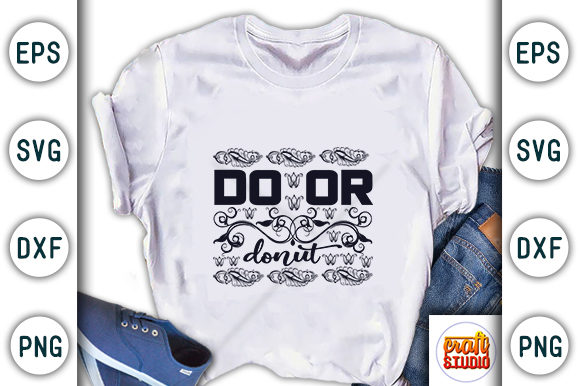
Do or Donut Quote
As someone who’s stitched hundreds of designs across apparel, home goods, and boutique merchandise, I opened Do or Donut Quote expecting charm—and got a surprisingly versatile little gem. It’s not just playful; it’s purpose-built for real-world making. I tested it on a soft-loop cotton tote bag destined for a local bakery’s staff gift set, and the moment the needle dropped, I knew this wasn’t just clip art—it was a ready-to-wear embroidery story.
A Design That Smiles Before It Stitches
The first thing that strikes you about Do or Donut Quote is its visual rhythm: clean, rounded letterforms paired with a simple donut icon (no sprinkles, no glaze swirls—just confident, friendly shape language). There’s zero visual noise. No overlapping elements. No thin serifs or fragile connectors. That matters—because in machine embroidery, simplicity isn’t lazy design; it’s stitch-smart design. The quote sits comfortably in a horizontal band, balanced and centered, making it ideal for chest placements on tees, front panels of aprons, or the upper corner of tea towels.
It reads instantly—even at 3.5 inches wide. That’s crucial when your finished product lands in someone’s hands: a customer shouldn’t lean in to decode it. They should grin, then snap a photo. I’ve seen too many “clever” quotes fall flat in stitch because the kerning collapsed or the “O” in “Donut” turned into a lopsided oval. Not here. This one holds its shape.
Where It Shines—and Where to Pause
Do or Donut Quote excels on medium-weight, stable fabrics: canvas totes, midweight cotton sweatshirts, denim jackets, and linen pillow covers. On a heavyweight organic cotton sweatshirt, the satin-stitched outlines popped beautifully against the nap—no sinking, no thread pooling. The fill stitches stayed even, with moderate density that kept the fabric from stiffening unnaturally.
It also works well as an embroidered patch—especially when fused to twill or duck cloth. The clean edges hold up during washing, and the modest height (no tall ascenders or deep descenders) means it won’t snag on zippers or seams.
But let’s be practical: avoid using Do or Donut Quote on highly textured surfaces like terry cloth towels or bouclé knit baby blankets unless you’re willing to double-stabilize and reduce stitch speed. The donut icon and letter spacing are generous, but they aren’t built for extreme stretch—so skip it on ribbed cotton onesies or performance-fabric leggings unless you’ve pressure-tested it first.
Also: while the design looks great on dark fabric in mockups, remember that light-colored thread on black fabric will need extra coverage. A single layer of fill may look translucent after laundering. If you’re embroidering for resale, test thread color contrast on your actual garment—not just on screen. Black-on-cream? Crisp. Cream-on-charcoal? Add a shadow underlay or opt for a slightly heavier fill.
Real Use, Real Impact
I used Do or Donut Quote on a set of kitchen towels for a small-batch Etsy listing. Paired with a subtle cross-stitch border (added manually), it elevated a basic cotton towel into a cohesive, giftable item. Customers didn’t just buy “a towel”—they bought “the donut towel,” and that distinction matters. It gave the shop personality. Same goes for personalized baby onesies: the design scaled cleanly down to 2.75 inches without losing legibility, and parents loved how it felt sweet—not cutesy—and inclusive (no gendered colors baked in).
For craft fairs or pop-up shops, Do or Donut Quote is low-risk, high-recognition. It’s snackable, shareable, and easy to brand. One client used it as the anchor motif on a line of embroidered caps—center-front, above the visor—and reported repeat orders purely based on how often people asked, “Where’d you get that?” That kind of organic engagement doesn’t come from complexity—it comes from clarity and warmth.
Designer Notes You’ll Actually Use
- Always test on scrap fabric first—especially if stitching on brushed fleece or lightweight rayon blends. Even simple designs can behave differently when stabilizer, tension, and fabric grain interact.
- Check stitch density in your embroidery software. If the fill areas look sparse in preview, add 5–10% density—particularly for commercial projects where durability matters.
- Confirm hoop size compatibility. While Do or Donut Quote fits comfortably in a 4×4 hoop, verify your machine’s maximum width before hooping—some compact models cut tight on horizontal space.
- Inspect corners and curves in your software preview. Look for any abrupt angle jumps or tiny gaps between letters. This design renders cleanly, but always verify—especially if converting from SVG or DXF to your machine’s native format.
- Test black-and-white mockups to assess contrast before choosing thread colors. What looks vibrant on screen may mute on fabric.
- Use cutaway stabilizer for knits, tear-away for stable wovens, and fusible + tear-away for layered items like reversible aprons.
- Review licensing terms carefully. Since Do or Donut Quote is marketed as a Graphics file for T-Shirt Designs and broader craft use, confirm whether resale of finished embroidered items is permitted—and whether digital redistribution (e.g., bundling in an embroidery kit) falls under allowed usage.
Final Thought: It’s Not Just a Quote—It’s a Conversation Starter
Do or Donut Quote doesn’t try to be everything. It’s not ornate. It’s not minimalist to the point of coldness. It’s warm, intentional, and quietly confident—like a well-made donut: simple ingredients, perfect execution, joyful impact. For embroidery designers building a library of reliable, sellable assets—or for crafters stitching gifts that feel personal without being precious—it earns its place. Not as filler. Not as trend bait. But as a thoughtful, stitch-ready piece of design that does exactly what it promises: makes people smile, then reach for seconds.