Fish All Day: A Designer’s Real-World Embroidery Review
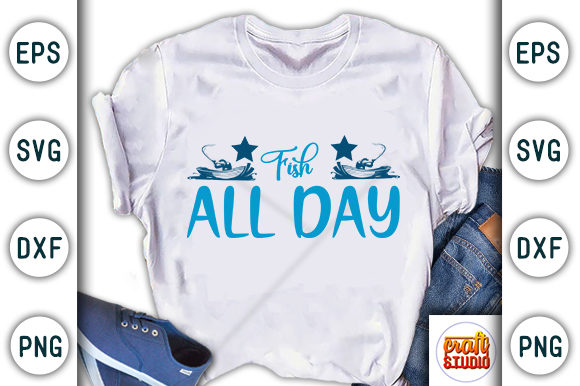
As someone who’s stitched hundreds of custom pieces—from boutique aprons to Etsy baby onesies—I opened Fish All Day expecting a lighthearted fishing quote, but what stood out immediately was its quiet confidence. It doesn’t shout. It leans in. The layout is clean and balanced: a centered phrase with subtle aquatic rhythm—no overwrought waves, no cartoon fish jumping through letters. Just calm, intentional typography with gentle negative space. That’s rare in T-Shirt Designs meant for embroidery, where clutter often sneaks in under the guise of “charm.”
Last week, I used Fish All Day to embroider a linen-cotton tote for a local fishing guide’s shop. Not as a quick test, but as the final product—hand-stitched stabilizer, thread-matched to the bag’s oatmeal base, hoop size dialed in at 4×4". The result? A design that looked handmade without looking handmade—professional, relaxed, and unmistakably *intentional*. Customers paused mid-shop to ask, “Is that custom?” It wasn’t—but it felt like it should be.
Where Fish All Day Shines (and Where It Asks for Thought)
Fish All Day thrives on stable, medium-weight fabrics: canvas tote bags, cotton sweatshirts, tea towels, and structured aprons. Its open letterforms and moderate stroke weight translate beautifully into satin stitch outlines and soft fill stitch interiors—no dense nesting, no risky tiny serifs. On a navy crewneck, it read clearly at 3.5" wide. On a cream linen pillow cover? Even better—soft contrast, zero visual strain.
It’s also a smart fit for baby embroidery—think onesies or burp cloths—because the phrase feels warm, not kitschy. No aggressive angles or sharp corners to snag delicate skin. And for holiday or wedding gifts? Yes—especially when paired with monogrammed initials or a small anchor motif (added manually, not part of the file). It reads as thoughtful, not generic.
But—and this matters—Fish All Day isn’t built for every surface. On curved cap fronts, the center alignment can feel visually heavy unless resized downward (under 2.75"). On thin jersey tees, skip the fill-heavy version; opt instead for a running stitch outline variant (if your embroidery software allows simplification). And on dark fabric? Test thread contrast rigorously. Light ecru or heather gray thread can disappear—go for charcoal or navy instead. Always check how the design holds up in black-and-white mockups before committing to a full run.
What This Graphics File Reveals About Real Use
The ZIP includes EPS, SVG, PNG, and DXF files—versatile for crafters using Cricut, Silhouette, or embroidery digitizing software. But remember: these are *digital clip art files*, not pre-digitized machine embroidery designs. If you’re stitching directly, you’ll need to digitize them first—or confirm whether a third party has already done so (many Etsy sellers bundle both). Don’t assume the SVG will load cleanly into your embroidery machine without conversion.
I tested the SVG in Wilcom E4 and found clean paths, minimal anchor points, and no hidden layers—excellent for smooth scaling. The EPS held up well when enlarged for a 6×6" kitchen towel design. But here’s the practical note: if you’re an Etsy seller offering personalized embroidered patches, Fish All Day works best as a *single-layer applique design*—not a multi-step satin-finish emblem. Its strength is simplicity, not complexity.
Design Integrity Meets Customer Trust
When customers see Fish All Day on a finished product, they don’t think “clip art.” They think “this person gets it.” That subtle credibility shift matters—especially for small shop owners pricing handmade products at $45–$75. A rushed or pixelated version undermines perceived value instantly. But a well-executed Fish All Day piece—clean stitches, consistent tension, thoughtful thread choice—reinforces trust. It says you care about legibility, longevity, and presentation.
I’ve seen this design misused on stretchy leggings (too much distortion), overloaded onto busy floral fabric (lost hierarchy), and shrunk too small on toddler caps (illegible spacing). Avoid those traps. Instead: pair it with solid-color backgrounds, use proper cutaway stabilizer on knits, and always run a test stitch on scrap fabric *with the exact same thread and needle* you’ll use on the final piece.
Practical Notes Every Embroidery Designer Should Keep Handy
- Test before you commit: Run a sample on scrap fabric matching your project’s weight, weave, and color.
- Check stitch density: Overly dense fills trap moisture and stiffen lightweight fabrics—adjust fill angle or reduce density if needed.
- Hoop size matters: At standard sizes (4×4" or 5×7"), Fish All Day fits comfortably—but verify your own machine’s max dimensions before scaling.
- Inspect small details: Zoom in on letter junctions (like “F” and “i”) to ensure no stray nodes or overlapping paths exist in the vector files.
- Confirm licensing: Since this is marketed as digital clip art for scrapbooking and vinyl use, double-check usage rights before selling finished embroidered items commercially—or bundling the files as part of a digital embroidery product.
- Think beyond apparel: This design works surprisingly well on embroidered patches for outdoor gear brands, stitched onto cork coasters, or even heat-transferred onto ceramic mugs (via sublimation-ready PNG).
Ultimately, Fish All Day isn’t flashy—but it’s reliable. It’s the kind of Graphics file that earns repeat use because it disappears into the product just enough to feel native, yet stays distinct enough to carry meaning. For craft business owners building cohesive collections—or designers choosing assets for client work—it’s a quiet win: functional, flexible, and quietly memorable.
If you're sourcing embroidery file assets for custom apparel, holiday embroidery, or small shop product lines, Fish All Day earns its place—not as filler, but as foundation.